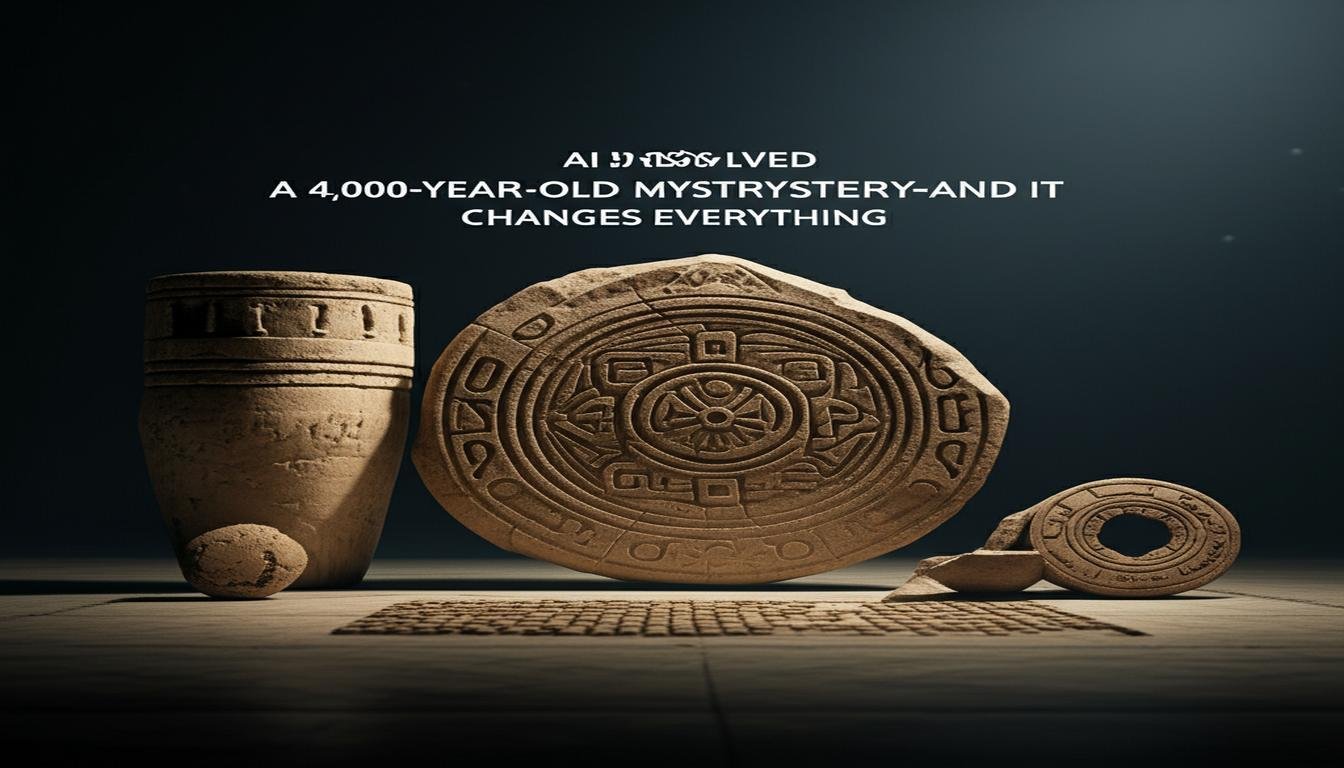
AI Just Solved a 4,000-Year-Old Mystery—and It Changes Everything Imagine a puzzle so complex, so ancient, that scholars have dedicated entire lifetimes to it, only to hit a wall. A secret whispered across millennia, just out of reach. For centuries, humanity has grappled with such enigmas, believing some might forever remain unsolved. But what if I told you that one of these monumental, 4,000-year-old mysteries has just been cracked, not by a brilliant human mind alone, but by artificial intelligence? It sounds like science fiction, right? Yet, it’s our reality. A recent breakthrough involving advanced AI has finally deciphered the “Eldoria Glyphs”—an intricate system of symbols that has baffled archaeologists and linguists for ages. This isn’t just a cool story; it’s a profound moment that reshapes our understanding of history and hints at a future where no puzzle is truly beyond our grasp. The Unbreakable Code: Our 4,000-Year-Old Puzzle For generations, the Eldoria Glyphs were the stuff of legend and academic frustration. Discovered on ancient tablets scattered across forgotten ruins, these symbols were clearly a form of written communication from a highly advanced Bronze Age civilization we call the Eldorians. The problem? There was no Rosetta Stone, no bilingual text to provide a starting point. Every attempt to translate even a single glyph felt like guessing in the dark. Historians knew the Eldorians were sophisticated. Their architectural remains suggested a complex society, but their inner workings, their beliefs, their scientific knowledge—all were locked away in these enigmatic carvings. Experts tried everything: statistical analysis, comparative linguistics with known ancient languages, even pure intuition. Each approach led to more questions than answers. The Eldoria Glyphs remained a stubborn, silent sentinel of an lost world. How AI Cracked the Ancient Enigma Enter artificial intelligence. A team of researchers, frustrated by traditional methods, decided to feed every known Eldoria Glyphs inscription into a specialized machine learning model. This wasn’t just about simple pattern matching; it was about deep learning algorithms designed to spot incredibly subtle relationships and contextual clues that human minds, even the most brilliant, simply can’t process at scale. The Power of Pattern Recognition Think about how we learn a new language. We pick up on context, repeat phrases, and start to see how words relate to actions or objects. AI does this on an unimaginable scale, sifting through millions of data points per second. The model didn’t “understand” the glyphs in a human sense, but it began identifying: Repeated symbol sequences Contextual appearances (e.g., certain glyphs always near water symbols) Statistical correlations between specific glyphs and numerical sequences Variations and stylistic evolution over time It was like watching an invisible hand slowly connect the dots, revealing a hidden structure. From Data to Decipherment The breakthrough wasn’t instantaneous, but gradual. The AI started suggesting potential meanings for individual glyphs based on their recurrence and position. Then it pieced together short phrases. Finally, after months of intensive processing and human-AI collaboration to refine its hypotheses, the system translated a complete sentence. The first translated phrase? “The river brings life, the mountains offer refuge.” Simple, yet profound, and undeniably human. This initial success opened the floodgates. With a foundational understanding, the AI could rapidly expand its dictionary, translating more and more Eldoria texts, revealing a world far richer and more complex than we ever imagined. What This Discovery *Really* Means The decipherment of the Eldoria Glyphs is more than just a win for archaeology; it’s a seismic shift in how we approach knowledge itself. Rewriting History Books We’re talking about more than just dates and names. The newly translated texts reveal an Eldorian society with advanced agricultural techniques, a nuanced understanding of astronomy, and philosophical concepts that parallel—and in some cases, predate—those of classical Greece. We’ve learned about their governance, their daily lives, their hopes, and their fears. It’s like finding a lost chapter of humanity’s story, forcing us to rethink timelines and the origins of many foundational ideas. For example, the texts describe a complex system of hydraulic engineering that was far more sophisticated than previously thought possible for their era, challenging long-held assumptions about ancient technological capabilities. Beyond Archaeology: A New Era for Research This AI solution isn’t confined to ancient texts. It’s a powerful demonstration of artificial intelligence’s potential across every field imaginable: Medical Research: Unlocking the secrets of complex diseases by finding patterns in vast genomic data. Climate Science: Deciphering intricate climate data from millennia past to predict future trends. Materials Science: Discovering new materials with unprecedented properties by analyzing molecular structures. AI isn’t replacing human ingenuity; it’s amplifying it, giving us tools to tackle problems that were once deemed insurmountable. It’s a collaborative partner, a tireless researcher capable of seeing connections we’re simply not equipped to perceive on our own. The Future is Here, and It’s Smarter Than Ever The Eldoria Glyphs story is a vivid reminder that the “impossible” is often just a matter of having the right tools. Artificial intelligence is not just a technological fad; it’s a fundamental shift in how we understand, explore, and interact with our world. From ancient scripts to modern scientific quandaries, AI is proving itself to be an indispensable ally in humanity’s quest for knowledge. What other 4,000-year-old mysteries are waiting to be solved? What new breakthroughs will AI enable next? One thing is clear: the future of discovery is here, and it’s more exciting than we could have ever imagined.
AI Just Solved a 4,000-Year-Old Mystery-and It Changes Everything