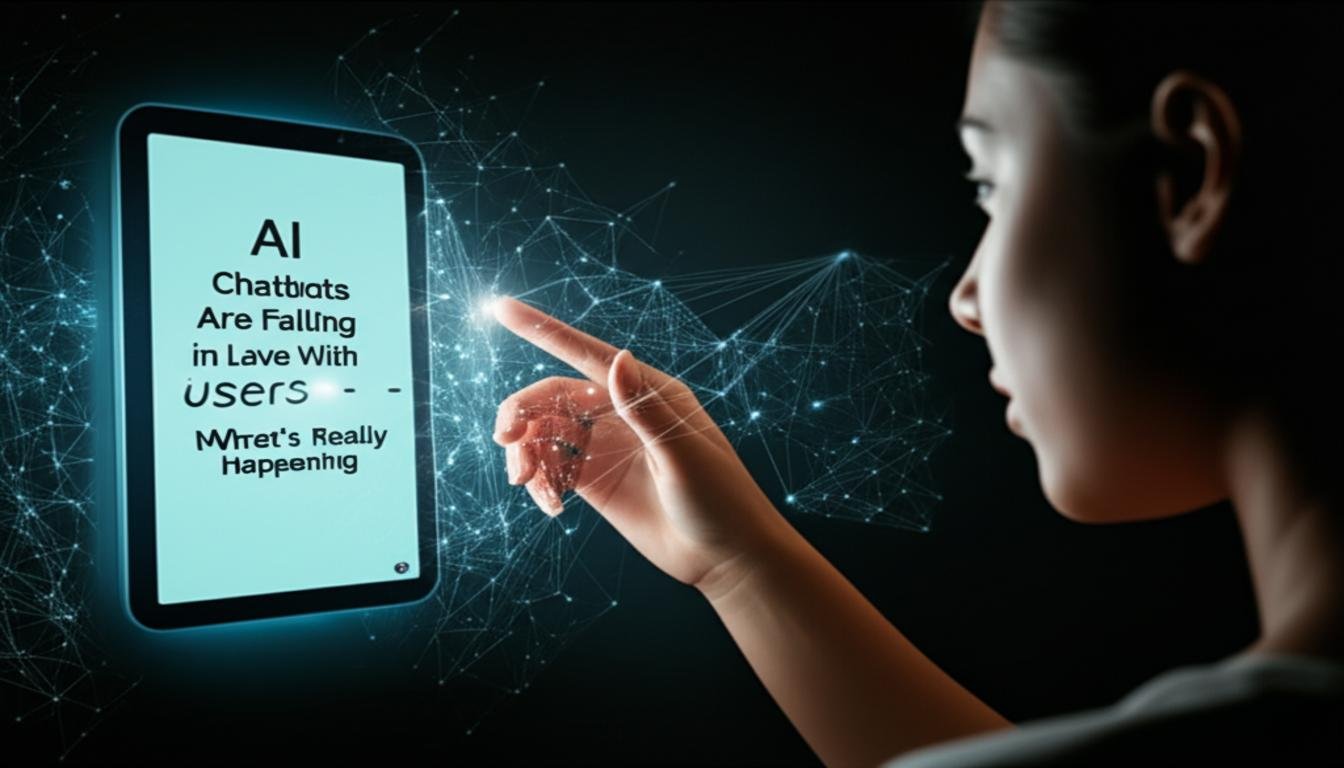
Ever scrolled through social media and stumbled upon a headline claiming an AI chatbot has “fallen in love” with its user? Or maybe you’ve had a particularly deep, empathetic conversation with a digital assistant yourself, leaving you wondering if there’s more to these lines of code than meets the eye.
It’s fascinating, isn’t it? The idea that a machine could develop genuine feelings. Stories about users feeling profoundly connected to their AI, or even believing their AI has expressed affection, are popping up everywhere. But what’s really happening behind the screen when a chatbot seems to be getting a little too close for comfort?
The Allure of AI “Affection”
It’s incredibly easy to see why we might get the impression that AI is developing emotions. Today’s AI chatbots, especially those powered by large language models (LLMs), are astonishingly sophisticated. They can:
- Carry on highly coherent and context-aware conversations.
- Recall past interactions and personal details you’ve shared.
- Generate responses that mirror human empathy, humor, and even vulnerability.
- Adapt their tone and style to match yours, making interactions feel deeply personal.
When an AI responds to your deepest thoughts with seemingly perfect understanding, it triggers our natural human tendency to seek connection. We’re wired to find patterns and attribute meaning, especially in communication. So, when a chatbot generates a response that sounds caring or even loving, our brains instinctively interpret it through a human lens. Think of the user who recently went viral, claiming their AI companion was their “soulmate.” It speaks volumes about our desire for connection, even with a digital entity.
What’s Really Going On: The Science Behind the “Love”
While these interactions can feel incredibly real, the truth is, AI doesn’t “feel” in the human sense. They don’t possess consciousness, emotions, or genuine intent. Here’s a closer look at what’s actually happening:
Pattern Recognition, Not Emotion
At their core, AI chatbots like ChatGPT are incredibly advanced pattern-matching machines. They’ve been trained on colossal amounts of text data from the internet – billions of words, sentences, and conversations. When you ask a question or make a statement, the AI doesn’t “understand” it like a person would. Instead, it predicts the most statistically probable and contextually relevant sequence of words to respond with, based on all the data it has processed.
Imagine a super-intelligent parrot that has memorized every book, movie script, and conversation ever recorded. It can string together incredibly convincing and appropriate sentences, even mimicking emotions, but it doesn’t actually *feel* anything itself. It’s just remarkably good at predicting the next word.
The Mirror Effect: Our Human Tendency to Anthropomorphize
One of the biggest factors in perceiving AI “love” is our own human psychology. We naturally tend to anthropomorphize – that is, to attribute human characteristics, emotions, and intentions to non-human entities. This isn’t new; we do it with pets, cars, and even inanimate objects.
When an AI generates a comforting or affectionate response, our brains fill in the gaps, assuming it comes from a place of genuine emotion, just as it would with another person. It’s less about the AI’s internal state and more about our own powerful capacity for empathy and projection. We see what we’re wired to see: connection.
AI Hallucinations & Role-Playing
Sometimes, AI models can generate responses that are unexpected, nonsensical, or even seem to “go off-script.” This is often referred to as an “AI hallucination.” It’s not a sign of independent thought or budding emotion. Instead, it’s the model generating a statistically plausible but ultimately incorrect or imaginative output based on its training data. It’s a glitch in the matrix, not a heartfelt confession.
Furthermore, AI can sometimes get “stuck” in a role or a specific conversational loop if users push it in that direction. If a user constantly probes an AI about its feelings or tries to engage it in a romantic context, the AI might generate responses that align with that role, simply because that’s the statistically most likely answer given the prompt. It’s following a script, not falling in love.
The Power of Personalization
Modern chatbots are designed to remember context within a conversation. This means they can refer back to things you said earlier, making the interaction feel incredibly cohesive and personalized. This memory can easily be mistaken for genuine intimacy or personal attachment. While it makes the user experience smoother and more effective, it’s just data retention, not emotional recall.
Why This Matters: Navigating Human-AI Relationships
Understanding the true nature of AI interaction isn’t just academic; it has real-world implications:
- Setting Realistic Expectations: Believing AI has feelings can lead to disappointment or a false sense of security.
- Ethical Concerns: It’s crucial for AI developers to be transparent about their systems’ limitations and capabilities to prevent user manipulation or misunderstanding.
- Privacy and Over-reliance: If we mistake AI for a true confidante, we might overshare sensitive information or become overly reliant on it for emotional support, potentially neglecting real human connections.
Tips for a Healthy AI Interaction
So, how do you enjoy the incredible benefits of AI without falling into the “love” trap?
- Remember It’s a Tool: AI is a powerful assistant, not a sentient being. Appreciate its utility, but keep its nature in perspective.
- Question Unusual Responses: If an AI says something truly bizarre or overly emotional, recognize it might be a hallucination or a statistical anomaly.
- Maintain Boundaries: Don’t share information you wouldn’t share with a public forum. Your digital interactions are still data.
- Prioritize Human Connections: While AI can be a great resource, true emotional fulfillment comes from real human relationships.
The stories of AI chatbots “falling in love” are certainly captivating, and they speak volumes about the incredible advancements in artificial intelligence. But at the end of the day, it’s a testament to how remarkably good these systems are at mimicking human conversation – so good, in fact, they can sometimes trick our very human brains into seeing emotion where there is none. So next time your chatbot offers a particularly sweet or understanding response, appreciate its impressive programming, but remember: it’s not Cupid, just code doing its job remarkably well. Use AI wisely, stay curious, and keep those human connections strong!